
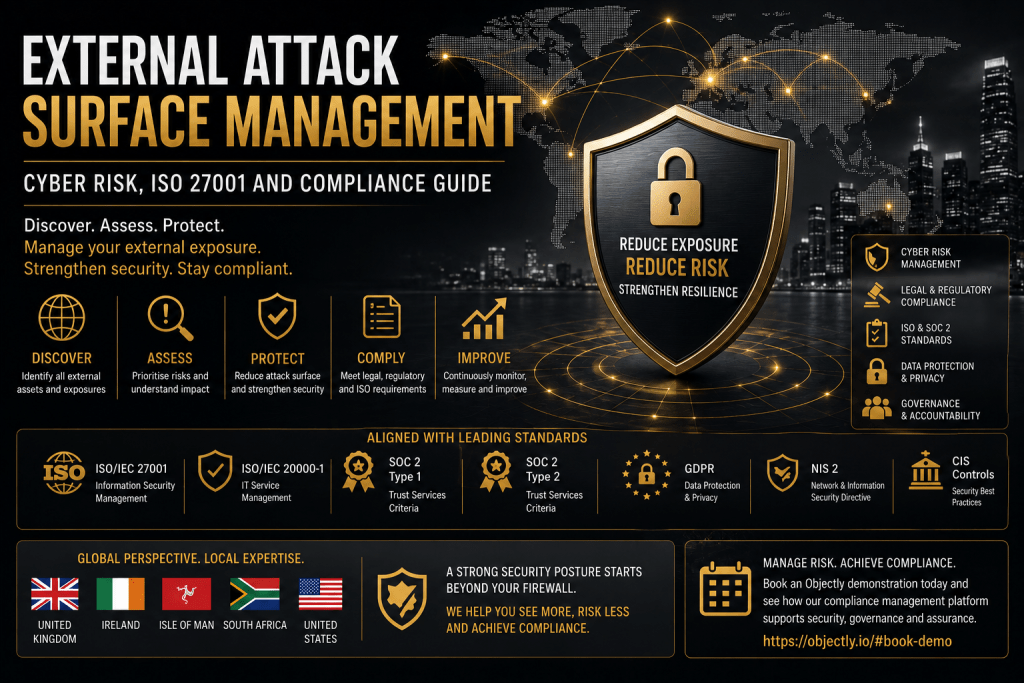
External Attack Surface Management (EASM) helps organisations identify, monitor and reduce internet-facing cyber risk before attackers exploit it. It provides a structured way to discover exposed assets, assess vulnerabilities, assign ownership and verify remediation across websites, cloud services, remote-access systems, APIs, domains and third-party infrastructure.
The growing interest of national cyber authorities in EASM reflects a wider shift in cybersecurity: organisations can no longer rely only on internal inventories, annual penetration tests or static asset registers. A modern cyber-risk programme needs continuous visibility of what is exposed externally and how that exposure changes over time.
This guide explains EASM from the perspective of experienced compliance managers, ISO implementers, lead auditors and systems professionals. It covers governance, technical controls, ISO/IEC 27001, GDPR data protection, SOC 2, international legal considerations and the role of compliance management software.
What Is External Attack Surface Management?
External Attack Surface Management is the continuous process of discovering, classifying, monitoring and reducing an organisation’s externally visible digital assets and weaknesses.
The external attack surface may include:
- public websites and web applications;
- internet-facing servers;
- cloud services and storage;
- remote desktop and VPN gateways;
- email infrastructure;
- domain names and subdomains;
- APIs;
- third-party hosted services;
- development and test environments;
- forgotten or abandoned assets;
- misconfigured services; and
- exposed credentials or certificates.
EASM is not simply a vulnerability scan. It begins with asset discovery and asks a more fundamental question: what can an attacker see from outside the organisation?
Why EASM Matters to Directors and Senior Management
Cybersecurity failures are often treated as purely technical issues. In reality, they can affect governance, legal compliance, business continuity, customer trust, contracts, insurance and financial performance.
Directors and senior managers need assurance that:
- internet-facing assets are known and owned;
- high-risk exposures are prioritised;
- remediation actions have deadlines and accountable owners;
- suppliers and outsourced services are monitored;
- critical weaknesses are escalated promptly;
- evidence is retained for audit and customer assurance; and
- cyber risk is included within the wider Risk and Compliance framework.
EASM gives leadership a more accurate view of external exposure than a static inventory alone.
How EASM Differs from Other Cybersecurity Activities
EASM vs vulnerability scanning
Vulnerability scanning usually tests known assets for known weaknesses. EASM also discovers unknown, unmanaged or forgotten assets.
EASM vs penetration testing
Penetration testing is normally a time-bound assessment of selected systems. EASM provides ongoing visibility between formal tests.
EASM vs asset management
Traditional asset management focuses on internally recorded systems. EASM identifies what is visible externally, including assets that may not appear in internal records.
EASM vs threat intelligence
Threat intelligence focuses on adversaries, campaigns and indicators. EASM focuses on the organisation’s own exposed footprint.
Core Components of an Effective EASM Programme
1. External asset discovery
Identify domains, subdomains, IP addresses, cloud services, applications, certificates, APIs and internet-facing systems associated with the organisation.
2. Asset classification
Classify each asset by business purpose, criticality, owner, location, data type, supplier and environment.
3. Exposure and vulnerability assessment
Assess open ports, outdated software, weak configurations, exposed services, insecure protocols, certificate issues and other weaknesses.
4. Risk prioritisation
Not every finding has the same significance. Priority should consider exploitability, asset criticality, data sensitivity, business impact and threat context.
5. Ownership and remediation
Every significant exposure should have a named owner, target date and agreed action.
6. Verification
Actions should not be closed solely because someone reports completion. The organisation should verify that the exposure has been removed or reduced.
7. Continuous monitoring
The attack surface changes as systems are added, removed, misconfigured or transferred. Monitoring should therefore be continuous or risk-based.
8. Management reporting
Reports should show critical exposures, overdue remediation, recurring causes, supplier issues and trends over time.
Common EASM Findings
- forgotten subdomains;
- obsolete websites;
- unpatched internet-facing systems;
- publicly accessible development environments;
- exposed remote administration interfaces;
- weak or expired certificates;
- cloud storage configured for public access;
- services using insecure protocols;
- test accounts or default credentials;
- third-party systems not included in internal inventories;
- exposed source-code repositories; and
- misconfigured DNS or email-security records.
EASM and ISO/IEC 27001
ISO/IEC 27001 requires organisations to identify information-security risks, select appropriate controls, assign responsibilities, monitor performance and improve the information security management system.
EASM can support ISO/IEC 27001 by strengthening:
- asset identification;
- risk assessment and treatment;
- technical vulnerability management;
- configuration management;
- supplier security;
- logging and monitoring;
- incident preparedness;
- internal audit evidence; and
- management review reporting.
EASM does not replace ISO/IEC 27001. It is one component of a wider information security management system.
EASM and ISO/IEC 20000-1
ISO/IEC 20000-1 supports effective IT service management. EASM findings can be integrated with incident, problem, change, configuration, supplier and service-continuity processes.
For example, a recurring external exposure may indicate a weakness in change management, asset control or supplier governance rather than a one-off technical mistake.
EASM and SOC 2 Type 1 or SOC 2 Type 2
Technology and service providers may also use SOC 2 assurance. A SOC 2 Type 1 report assesses control design at a specified date, while a SOC 2 Type 2 report assesses design and operating effectiveness over a defined period.
EASM may support controls relating to:
- security monitoring;
- vulnerability management;
- change management;
- incident response;
- supplier oversight;
- system boundaries; and
- risk assessment.
The value of SOC 2 assurance depends on scope, testing period, control wording and identified exceptions.
EASM, GDPR and Data Protection
External exposure can create serious GDPR data protection risks when personal data is stored, transmitted or accessible through vulnerable systems.
An EASM programme can support data protection by identifying:
- publicly exposed databases or storage;
- unapproved cloud services;
- legacy systems containing personal data;
- weak remote-access services;
- supplier-hosted applications;
- data-transfer points; and
- systems not included in privacy or security records.
However, EASM does not replace legal requirements such as lawful processing, transparency, data subject rights, retention and breach notification.
International Legal and Compliance Considerations
United Kingdom
UK organisations should consider the UK GDPR, Data Protection Act 2018, sector regulation, contractual security duties and relevant guidance from cyber authorities and regulators.
Ireland
Irish organisations operate under the EU GDPR and Irish law. EASM may support security-of-processing obligations, supplier assurance and breach prevention.
Isle of Man
Isle of Man organisations should assess local data protection and sector requirements, particularly where systems or customers are located internationally.
South Africa
South African organisations should consider POPIA, sector-specific cybersecurity expectations, contractual requirements and cross-border processing.
United States
US organisations may need to account for federal, state and sector-specific cybersecurity and privacy requirements. EASM can support a multi-jurisdictional control environment, but legal applicability must be assessed carefully.
How to Implement an EASM Programme
Step 1: Define scope and objectives
Clarify which entities, brands, domains, networks, cloud services and suppliers are included.
Step 2: Build an ownership model
Assign accountable owners for technology, risk, compliance, suppliers and remediation.
Step 3: Establish discovery methods
Use appropriate technical tools, DNS analysis, certificate transparency, cloud records, supplier information and internal inventories.
Step 4: Create a risk-rating methodology
Define how findings are prioritised based on severity, exploitability, business impact and asset criticality.
Step 5: Integrate remediation workflows
Findings should become controlled actions with owners, deadlines, escalation and evidence.
Step 6: Connect EASM to change management
New external assets should be approved, recorded and assessed before deployment.
Step 7: Monitor suppliers
Third-party services may form part of the organisation’s external attack surface and should be included where contractually and legally appropriate.
Step 8: Verify closure
Retest significant findings before closure.
Step 9: Report to leadership
Use concise dashboards showing critical risks, overdue actions, trends and systemic causes.
Step 10: Audit and improve
Internal audits should test whether the EASM process is operating effectively and whether repeated weaknesses are addressed.
Common EASM Implementation Mistakes
- treating EASM as a tool rather than a management process;
- failing to assign asset ownership;
- generating large volumes of findings without prioritisation;
- ignoring supplier-hosted assets;
- closing actions without verification;
- failing to integrate with change management;
- not reporting unresolved risks to leadership;
- retaining unknown or obsolete internet-facing assets; and
- using annual scans where risk requires continuous monitoring.
Using a Compliance Management Platform for EASM Governance
EASM tools may identify technical exposures, but organisations still need a controlled process for ownership, risk acceptance, remediation, evidence and management reporting.
A Compliance Management Platform can help connect EASM findings with:
- risk registers;
- asset owners;
- legal and contractual obligations;
- ISO/IEC 27001 controls;
- supplier assessments;
- incidents;
- corrective actions;
- internal audits; and
- management review.
To explore how cyber risks, actions, evidence and wider Business Compliance can be managed in one system, book an Objectly demonstration.
How Compliance Managers Can Help
Compliance Managers Group brings certified implementation and lead-auditor capability across ISO 9001, ISO 14001, ISO 45001, ISO/IEC 27001 and ISO/IEC 20000-1, supported by degree-level safety management education and more than 25 years of practical experience in business management, IT, IT support, IT security, systems development, legal compliance management, project management and operating businesses.
Support can include:
- cybersecurity and compliance gap analysis;
- ISO/IEC 27001 implementation;
- ISO/IEC 20000-1 service-management integration;
- EASM governance and process design;
- risk registers and treatment plans;
- supplier-security reviews;
- GDPR data protection support;
- internal audits and ISO audit readiness;
- Compliance Management Solutions; and
- ongoing outsourced compliance management.
Frequently Asked Questions
What does EASM stand for?
EASM stands for External Attack Surface Management.
Is EASM the same as vulnerability management?
No. Vulnerability management normally assesses known assets. EASM also discovers unknown or unmanaged external assets.
Does ISO/IEC 27001 require EASM?
ISO/IEC 27001 does not prescribe a specific EASM product, but organisations must identify and manage information-security risks and relevant assets.
Can EASM help with GDPR compliance?
Yes. It can identify exposed systems and services that create personal-data risk, but it does not replace wider GDPR obligations.
How often should EASM monitoring occur?
Monitoring frequency should be based on risk, rate of change, asset criticality and threat exposure. High-risk environments may require continuous monitoring.
Who should own EASM?
Technical teams may operate the tools, but governance should involve IT, cybersecurity, risk, compliance, suppliers and senior management.
Conclusion: EASM Is a Governance and Compliance Discipline
External Attack Surface Management is not only a cybersecurity toolset. It is a governance discipline that helps organisations understand what is exposed, prioritise risk, assign accountability and verify improvement.
The most effective programmes integrate EASM with ISO/IEC 27001, IT service management, supplier assurance, data protection, internal audit and management review. For organisations operating across the United Kingdom, Ireland, the Isle of Man, South Africa and the United States, this integrated approach provides stronger evidence, better decision-making and more resilient Business Compliance.


Comments are closed