
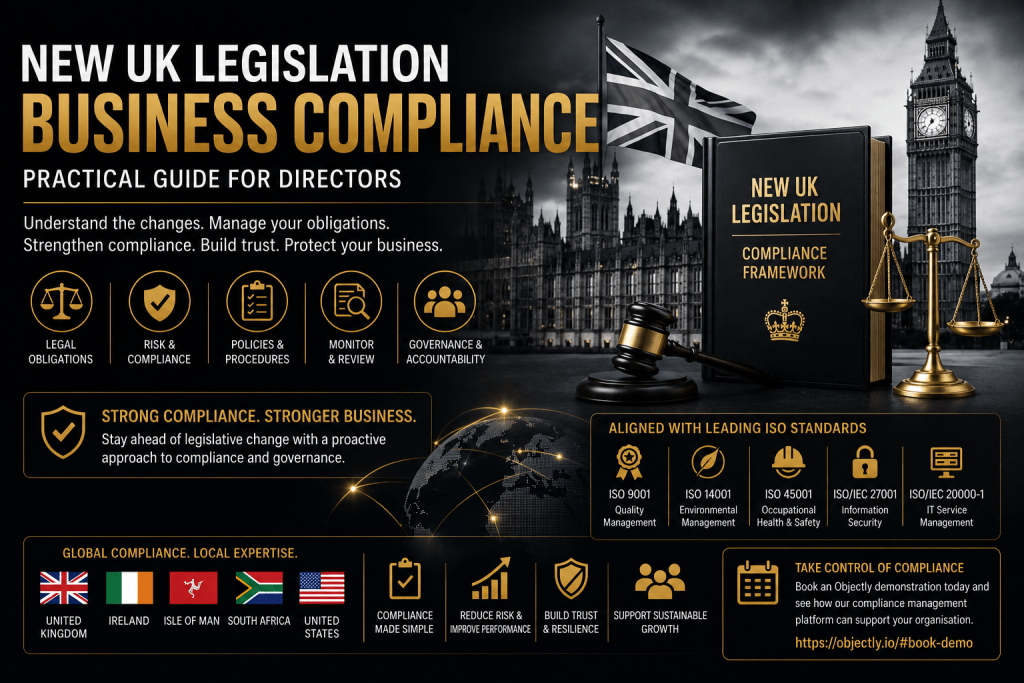
New legislation can create immediate operational, contractual and governance obligations for businesses. Directors and senior managers need a structured process for identifying legal changes, assessing their impact, assigning responsibilities, updating controls and retaining evidence that the organisation has responded appropriately.
This guide explains how organisations can manage regulatory change and legal compliance across the United Kingdom, while also drawing practical comparisons for businesses operating in Ireland, the Isle of Man, South Africa and the United States. It is written from the perspective of experienced compliance practitioners, implementers and lead auditors who understand that legal compliance cannot be managed effectively through ad hoc emails or isolated spreadsheets.
Why New Legislation Matters to Business Compliance
Legislative change can affect almost every part of an organisation, including employment, tax, immigration, data protection, health and safety, environmental obligations, financial controls, procurement, customer contracts and reporting.
The key risk is not simply that a law changes. The greater risk is that the organisation fails to recognise the change, misunderstands its relevance or cannot demonstrate that appropriate action was taken.
A mature Business Compliance framework should therefore be able to answer:
- Which legal changes apply to us?
- Which entities, locations and activities are affected?
- Who owns the response?
- What policies, contracts, systems or training must change?
- What deadlines apply?
- What evidence demonstrates compliance?
- How will effectiveness be reviewed?
What Is Regulatory Change Management?
Regulatory change management is the controlled process used to identify, assess, implement and monitor changes in laws, regulations, standards and contractual obligations.
It normally includes:
- legal and regulatory horizon scanning;
- impact assessment;
- assignment of accountable owners;
- implementation planning;
- policy and procedure updates;
- training and communication;
- control testing;
- evidence retention; and
- management reporting.
This process should form part of the organisation’s wider Risk and Compliance system.
Directors’ Responsibilities for Legal Compliance
Directors and senior leaders are responsible for ensuring that the organisation has suitable governance, competent people and adequate resources to meet applicable obligations. While day-to-day tasks may be delegated, accountability for effective oversight remains with leadership.
Directors should expect regular reporting on:
- new and changing legal obligations;
- high-risk compliance gaps;
- overdue actions;
- significant incidents or breaches;
- audit findings;
- regulator or customer concerns; and
- the effectiveness of corrective action.
Good governance requires more than approving a policy. Leaders should verify that legal obligations have been translated into working controls.
How New UK Legislation Can Affect Different Business Areas
Employment and workforce compliance
Changes to immigration, worker rights, pay, equality or employment status can affect recruitment, contracts, right-to-work checks, onboarding and HR records.
Tax and financial controls
Changes involving VAT, exemptions, reporting or financial thresholds may require system changes, revised procedures, staff training and updated customer or supplier communications.
Data protection and cybersecurity
New rules affecting personal data, digital services, online safety or cybersecurity may require updates to privacy notices, supplier contracts, access controls, incident response and data-retention practices.
Health, safety and environmental compliance
New requirements can affect risk assessments, permits, inspections, employee consultation, training, emergency arrangements and reporting.
Procurement and tenders
Public and private-sector buyers may update supplier requirements after legislative change. Businesses may need to provide new policies, declarations, certifications or evidence.
Building an Effective Legal Compliance Framework
1. Maintain a legal and compliance register
The register should identify applicable laws, regulations, licences, permits, contractual obligations and other mandatory requirements. Each item should have an owner, applicability statement, review date and evidence reference.
2. Assign accountable owners
Every significant obligation should have a named owner with sufficient authority and competence.
3. Assess impact and priority
Not every legal change has the same effect. Organisations should assess scope, implementation deadlines, financial impact, operational complexity, enforcement risk and stakeholder expectations.
4. Update policies and procedures
Legal changes should be translated into controlled internal documents, procedures and work instructions.
5. Train relevant employees
Training should be role-specific. A legislative update that affects only payroll, procurement or information security may not require organisation-wide training.
6. Test implementation
Internal audits, file reviews, control testing and management checks should confirm that changes are working in practice.
7. Report to leadership
Management reporting should focus on high-risk changes, implementation status, overdue actions and unresolved gaps.
How ISO Standards Support Legal Compliance
ISO 9001
ISO 9001 supports controlled processes, documented information, customer requirements, internal audits and corrective action.
ISO 14001
ISO 14001 requires organisations to determine and evaluate environmental compliance obligations.
ISO 45001
ISO 45001 requires organisations to identify legal and other occupational health and safety requirements and evaluate compliance.
ISO/IEC 27001
ISO/IEC 27001 supports identification of legal, regulatory and contractual information-security obligations.
ISO/IEC 20000-1
ISO/IEC 20000-1 can help organisations manage legal, contractual and service-management requirements affecting IT services.
ISO certification does not replace legal compliance. It provides a management-system structure for identifying obligations, assigning controls, reviewing performance and improving weaknesses.
Legal Compliance Across Different Jurisdictions
United Kingdom
UK organisations need a process for monitoring Parliament, regulators, statutory guidance and sector bodies. The relevant obligations will vary by industry and location.
Ireland
Irish businesses operate within EU and Irish law. Regulatory change may come from EU regulations, directives, national legislation and sector regulators.
Isle of Man
Isle of Man organisations should monitor local legislation and regulation rather than assume that UK changes apply automatically.
South Africa
South African organisations may need to monitor POPIA, labour law, occupational health and safety, environmental requirements and sector-specific obligations.
United States
US compliance programmes often need to account for federal, state and sector-specific requirements. A change may apply in one state but not another.
Common Regulatory Change Management Failures
- relying on informal email alerts;
- failing to assess applicability;
- no accountable owner;
- updating a policy without changing the process;
- missing implementation deadlines;
- failing to train affected employees;
- no evidence that controls were tested;
- legal registers not reviewed; and
- boards receiving overly technical or incomplete reporting.
Using Compliance Management Software
Managing legal obligations through disconnected spreadsheets creates duplication, missed reviews and weak evidence. A Compliance Management Platform can centralise legal registers, obligations, owners, actions, policies, audits and supporting evidence.
Effective Compliance Management Tools can help organisations:
- maintain jurisdiction-specific legal registers;
- assign owners and implementation dates;
- link legal obligations to policies and controls;
- track changes and overdue actions;
- retain audit evidence;
- produce management reports; and
- support ISO audit readiness.
To explore how regulatory change, legal registers and wider Business Compliance can be managed in one system, book an Objectly demonstration.
How Compliance Managers Can Help
Compliance Managers Group brings certified implementation and lead-auditor capability across ISO 9001, ISO 14001, ISO 45001, ISO/IEC 27001 and ISO/IEC 20000-1, supported by degree-level safety management education and more than 25 years of practical experience in business management, IT, IT support, IT security, systems development, legal compliance management, project management and operating businesses.
Support can include:
- legal and compliance register development;
- regulatory change processes;
- impact assessments;
- policy and procedure updates;
- ISO implementation and integration;
- internal audits;
- management reporting;
- Compliance Management Solutions; and
- ongoing outsourced compliance support.
Frequently Asked Questions
How should a business monitor new legislation?
Use a defined horizon-scanning process supported by legal updates, regulators, professional advisers, industry bodies and internal review.
Does every legal change require a new policy?
No. Some changes require amendments to procedures, contracts, systems or training rather than a new policy.
Can ISO certification prove legal compliance?
No. ISO certification can support legal compliance management, but it does not automatically prove that all laws have been met.
Who should own legal compliance?
Leadership remains accountable, while individual obligations should be assigned to competent owners within the relevant functions.
How often should a legal register be reviewed?
Review frequency should be risk-based and should increase when the organisation, law or operating environment changes.
Conclusion: Legal Compliance Requires a Controlled System
New legislation should be managed through a controlled, evidence-based process. Effective organisations identify changes early, assess relevance, assign accountability, implement controls and verify that the response is working.
For businesses operating in the UK and internationally, regulatory change management should form part of a wider Risk and Compliance framework rather than being treated as a one-off legal exercise. Compliance Managers can help organisations build practical systems that support governance, certification and sustainable growth.


Comments are closed