
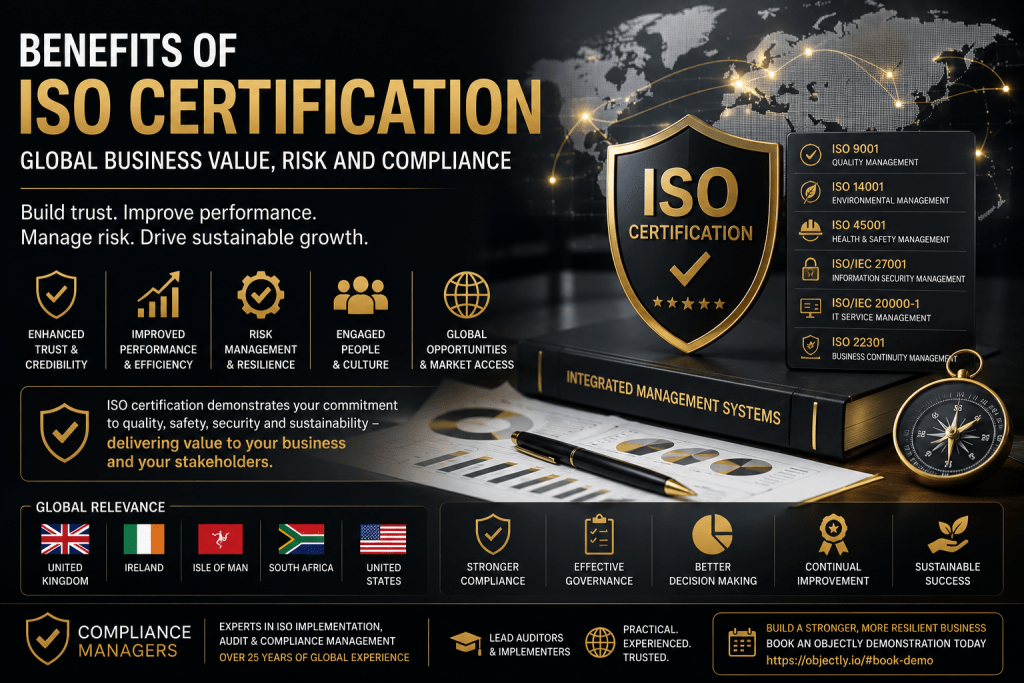
ISO certification can improve governance, operational consistency, customer confidence, tender readiness and risk control. Its value, however, depends on how well the management system is implemented. A certificate alone does not create compliance, reduce risk or improve performance; the benefit comes from disciplined processes, competent leadership, reliable evidence and continual improvement.
For organisations operating in the United Kingdom, Ireland, the Isle of Man, South Africa and the United States, ISO certification can provide a common international framework across multiple legal and commercial environments. This guide explains the strategic benefits, practical limitations and ongoing relevance of ISO certification from the perspective of experienced implementers and lead auditors.
What Is ISO Certification?
ISO certification is independent confirmation that an organisation’s management system has been assessed against the requirements of a recognised ISO or ISO/IEC standard. Certification is issued by an external certification body; ISO itself develops and publishes standards but does not certify organisations.
Certification normally covers a defined scope, including specified activities, locations, products or services. A credible certificate should identify the applicable standard, certification body, issue and expiry dates and the precise scope of certification.
What Are the Main Benefits of ISO Certification?
1. Stronger governance and accountability
ISO management-system standards require defined responsibilities, leadership involvement, objectives, performance monitoring and formal review. This creates clearer accountability and helps ensure that significant Risk and Compliance issues reach the right level of management.
2. More consistent business processes
Documented and controlled processes reduce dependence on individual knowledge. This is particularly valuable when organisations grow, open new locations, recruit staff, acquire businesses or deliver services across multiple jurisdictions.
3. Improved customer confidence
Independent certification can provide customers with evidence that the organisation has implemented a structured management system. It does not guarantee perfect performance, but it can strengthen credibility during supplier selection and due diligence.
4. Better access to tenders and supply chains
Some tenders, customer contracts and approved-supplier programmes require certification or equivalent evidence. ISO 9001, ISO 14001, ISO 45001 and ISO/IEC 27001 are frequently used as commercial qualification criteria.
5. Improved risk management
Modern ISO standards require organisations to identify risks and opportunities. A properly implemented system can strengthen operational resilience, information security, quality, health and safety, environmental performance and business continuity.
6. More effective audits and corrective action
Internal audits, nonconformity management, root-cause analysis and corrective action help organisations identify weaknesses before they become serious failures. These activities also create evidence for an external ISO audit.
7. Continual improvement
ISO certification is intended to support ongoing improvement rather than one-time documentation. Objectives, data analysis, management review and corrective action should drive measurable changes in performance.
8. International consistency
A common management-system framework can help international groups apply consistent controls across the UK, Ireland, the Isle of Man, South Africa and the US while still addressing local legal obligations.
Benefits of Key ISO Standards
ISO 9001: Quality management
ISO 9001 supports consistent delivery, customer satisfaction, process control and continual improvement. It can be applied in manufacturing, technology, professional services, construction, healthcare, public services and many other sectors.
ISO 14001: Environmental management
ISO 14001 helps organisations identify environmental aspects, evaluate obligations, reduce environmental risk and improve performance. It can support customer requirements, supply-chain expectations and sustainability objectives.
ISO 45001: Occupational health and safety
ISO 45001 provides a framework for hazard identification, worker participation, risk control and improvement of occupational health and safety performance.
ISO/IEC 27001: Information security
ISO/IEC 27001 helps organisations manage information-security risks through a formal information security management system. It can support cybersecurity governance, customer assurance and GDPR data protection controls.
ISO/IEC 20000-1: IT service management
ISO/IEC 20000-1 supports effective IT service management, including service planning, incident handling, change management, service levels and continual improvement. It is particularly relevant to managed service providers, internal IT departments and technology businesses.
ISO 22301: Business continuity
ISO 22301 supports preparation for disruption, recovery priorities, continuity plans and resilience testing.
Is ISO Certification Still Relevant?
Yes. ISO certification remains relevant because organisations face increasing customer scrutiny, regulatory pressure, supply-chain risk, cybersecurity threats and expectations for transparent governance.
Its relevance is strongest where certification supports a clear business objective, such as:
- winning regulated or high-value contracts;
- entering new markets;
- standardising multi-site operations;
- strengthening cyber and data protection assurance;
- reducing health, safety or environmental risk;
- improving supplier governance; or
- supporting mergers, investment or due diligence.
Certification becomes less valuable when it is treated as a branding exercise rather than an operating system for the business.
Regional Relevance of ISO Certification
United Kingdom
UK businesses often use ISO certification to support public-sector procurement, regulated supply chains and customer assurance. UKAS-accredited certification may be important where recognised accreditation is required.
Ireland
Irish organisations use ISO standards alongside EU regulatory requirements and the EU GDPR. Certification can support cross-border trade, multinational customer requirements and consistent governance across European operations.
Isle of Man
Isle of Man businesses may use ISO certification to demonstrate international good practice while operating within a distinct legal jurisdiction. This can be valuable for financial services, technology, professional services and organisations serving UK or European markets.
South Africa
South African organisations may use ISO certification to support supply-chain confidence, tender requirements, operational control, occupational safety and compliance with POPIA and other local obligations.
United States
US organisations often use ISO certification for global supply chains, technology assurance, manufacturing quality, defence-related procurement and international customer requirements. ISO/IEC 27001 may be used alongside SOC 2 Type 1 or SOC 2 Type 2 assurance.
ISO Certification and Legal Compliance
ISO certification does not automatically prove legal compliance. Standards provide management-system requirements, while laws and regulations create legal duties.
For example:
- ISO 45001 does not replace health and safety law;
- ISO 14001 does not replace environmental permits or statutory obligations;
- ISO/IEC 27001 does not by itself prove compliance with GDPR Regulations, POPIA or US privacy laws; and
- ISO 9001 does not remove contractual or product-safety obligations.
A mature Business Compliance programme should map ISO controls to applicable legal, regulatory and contractual obligations.
ISO Certification and GDPR Data Protection
ISO/IEC 27001 can support GDPR data protection by creating structured processes for risk assessment, access control, incident response, supplier management and continual improvement. However, organisations must still address lawful basis, transparency, retention, individual rights and international transfers.
In Ireland, the EU GDPR applies. In the UK, the UK GDPR and Data Protection Act 2018 apply. The Isle of Man has its own data protection framework. South African organisations must consider POPIA, while US businesses may face sector-specific and state privacy requirements.
What Happens If a Business Is Not ISO Certified?
There is usually no general legal penalty for not being ISO certified. The consequences are more often commercial and operational.
A non-certified organisation may experience:
- exclusion from tenders or supplier lists;
- longer customer due diligence;
- reduced credibility in regulated or high-risk sectors;
- greater inconsistency between teams and locations;
- weaker audit evidence;
- less disciplined corrective action; or
- difficulty demonstrating governance to insurers, investors or partners.
However, certification is not always necessary. Some organisations can meet customer and legal requirements through a well-controlled but uncertified management system. The decision should be based on risk, cost, market expectations and strategic value.
Common Misconceptions About ISO Certification
Certification guarantees compliance
It does not. Certification is based on a sampled assessment of a defined management-system scope.
Certification means no problems will occur
It does not prevent incidents or nonconformities. A strong system helps the organisation identify, manage and learn from them.
More documentation means better compliance
Excessive documentation can make systems harder to use. The objective is effective control and reliable evidence.
The consultant can own the management system
External specialists can support implementation, but leadership and process owners must remain accountable.
Passing the certification audit is the end of the project
Certification starts an ongoing cycle of internal audits, surveillance audits, management review and improvement.
How to Maximise the Value of ISO Certification
- Link the management system to business strategy and customer requirements.
- Define meaningful objectives and performance measures.
- Integrate quality, environmental, safety, security and IT-service controls where appropriate.
- Use internal audits to test effectiveness, not merely clause compliance.
- Investigate root causes rather than closing superficial actions.
- Provide leadership with accurate Risk and Compliance reporting.
- Use management review to make decisions and allocate resources.
- Select an appropriately accredited certification body.
Using Compliance Management Software
Organisations managing several standards, locations and jurisdictions often struggle with disconnected spreadsheets and document folders. A Compliance Management Platform can centralise obligations, policies, risks, audits, actions, evidence and management reporting.
Effective Compliance Management Tools can help organisations:
- map shared controls across ISO 9001, ISO 14001, ISO 45001, ISO/IEC 27001 and ISO/IEC 20000-1;
- track internal audits and corrective actions;
- manage document approvals and review dates;
- maintain legal and compliance registers;
- monitor training, suppliers and incidents; and
- prepare evidence for certification and surveillance audits.
To explore how an integrated compliance platform can support ISO certification and Business Compliance, book an Objectly demonstration.
How Compliance Managers Can Help
Compliance Managers Group brings certified implementation and lead-auditor capability across ISO 9001, ISO 14001, ISO 45001, ISO/IEC 27001 and ISO/IEC 20000-1, supported by degree-level safety management education and more than 25 years of practical experience in business management, IT, IT support, IT security, systems development, legal compliance, project management and operating businesses.
Support can include:
- standard selection and certification strategy;
- gap analysis and implementation planning;
- integrated management-system design;
- legal and contractual compliance mapping;
- policies, procedures and risk registers;
- internal audits and lead-auditor support;
- management-review preparation;
- certification-body readiness;
- Compliance Management Solutions; and
- ongoing improvement and outsourced compliance management.
Frequently Asked Questions
Is ISO certification worth it for a small business?
It can be, particularly where certification supports tenders, customer confidence, operational consistency or growth. The system should remain proportionate to the size and complexity of the business.
Does ISO certification increase revenue?
Certification does not guarantee revenue, but it may improve tender eligibility, customer confidence and access to markets.
How long does ISO certification last?
Certificates normally operate within a certification cycle that includes periodic surveillance audits and eventual recertification. The organisation must maintain the system throughout the cycle.
Can one system cover multiple ISO standards?
Yes. Many ISO management-system standards share a common structure and can be integrated.
Is ISO certification the same as accreditation?
No. Certification bodies certify organisations. Accreditation bodies assess the competence of certification bodies.
Conclusion: Certification Must Deliver Business Value
ISO certification remains highly relevant when it supports real business needs. Its strongest benefits include improved governance, consistent processes, better risk control, customer confidence and access to markets.
The certificate is only the visible outcome. The real value lies in a management system that helps leaders control risk, meet obligations, improve performance and make better decisions across the United Kingdom, Ireland, the Isle of Man, South Africa and the United States.

Comments are closed