
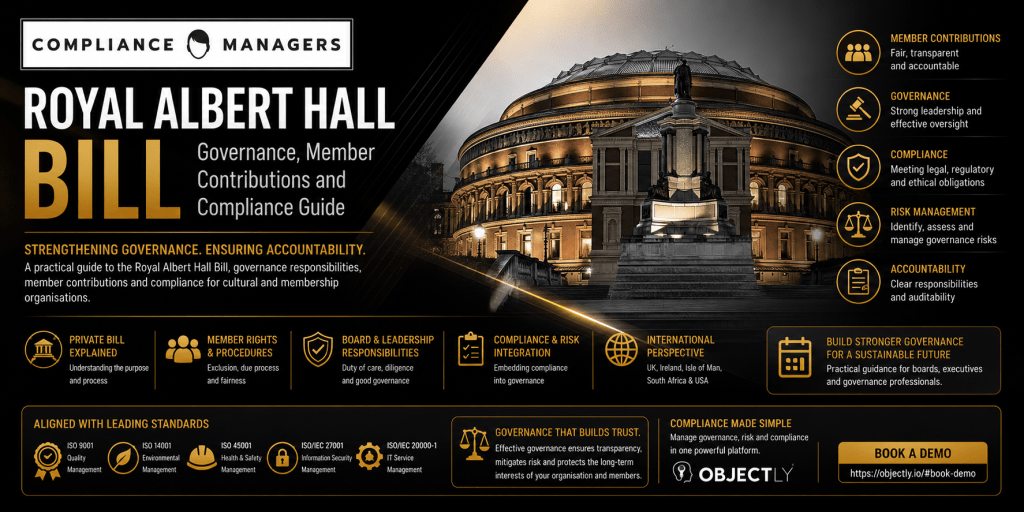
The Royal Albert Hall Bill [HL] is a private Bill intended to amend provisions of the Royal Albert Hall Act 1966 relating to annual contributions payable by Members of the Corporation and the exclusion of Members from the Hall. Its significance extends beyond one institution: the Bill provides a useful case study in governance, member rights, financial accountability, constitutional change and legal compliance for cultural, charitable and membership-based organisations.
This guide explains the Bill’s purpose, governance implications, practical compliance lessons and wider relevance for boards, trustees, company secretaries, compliance managers and senior executives. It also considers how organisations in the United Kingdom, Ireland, the Isle of Man, South Africa and the United States can apply similar governance principles within their own legal frameworks.
Executive Summary
- The Bill concerns annual member contributions and the circumstances in which Members may be excluded from the Royal Albert Hall.
- It is a private Bill rather than a general public Bill, because it changes arrangements affecting a specific body.
- The Bill passed through the House of Lords, entered the House of Commons, completed an unopposed Bill committee stage and has required revival across parliamentary sessions.
- The latest parliamentary record indicates that the next formal step is a motion to revive the Bill in the House of Commons.
- The governance lessons apply broadly to cultural institutions, membership corporations, charities and organisations governed by historic constitutions or bespoke legislation.
- Strong governance requires clear authority, transparent financial obligations, fair exclusion procedures, reliable records and board-level oversight.
What Is the Royal Albert Hall Bill?
The Royal Albert Hall Bill [HL] is a private Bill promoted to amend elements of the Royal Albert Hall Act 1966. Its long title focuses on two principal areas:
- annual contributions payable by Members of the Corporation towards the general purposes of the Royal Albert Hall; and
- further provision concerning the exclusion of Members from the Hall.
Because the Royal Albert Hall operates under a distinctive constitutional and statutory structure, changes to key governance arrangements may require legislation rather than an ordinary internal policy amendment.
What Is the Current Status of the Bill?
The Bill began in the House of Lords and passed through First Reading, Second Reading, Committee, Report and Third Reading before being sent to the House of Commons. It then completed Commons First Reading, Second Reading and an unopposed Bill committee stage.
Parliamentary records show that the Bill has been carried or revived across several sessions. The current status indicates that a motion to revive the Bill is the next stage in the House of Commons.
Because parliamentary timetables can change, organisations relying on the Bill should continue monitoring the official UK Parliament record rather than assuming that passage is complete.
Why the Bill Matters for Governance
The Bill raises several governance questions that are relevant far beyond the Royal Albert Hall:
- Who has authority to impose financial obligations on members?
- How should contribution levels be determined and communicated?
- What rights do members have to challenge or review decisions?
- When may a member be excluded from premises or participation?
- What procedural safeguards should apply?
- How should conflicts of interest be managed?
- What records demonstrate that decisions were lawful and fair?
These are core Business Compliance and governance issues. They affect accountability, legitimacy, stakeholder trust and the defensibility of board decisions.
Annual Member Contributions and Financial Governance
Member contributions can be a legitimate source of funding, but they should be governed by clear authority and transparent processes.
A robust contribution framework should define:
- the legal or constitutional basis for the contribution;
- who may set or approve the amount;
- how the amount is calculated;
- payment deadlines;
- consequences of non-payment;
- appeal or review arrangements;
- treatment of hardship or exceptional circumstances;
- how funds may be used; and
- how financial reporting will demonstrate accountability.
Member Exclusion and Procedural Fairness
Excluding a member from premises, events or participation can have significant legal and reputational consequences. Decisions should therefore be based on clear authority, evidence and fair procedure.
A defensible process should normally include:
- a defined ground for exclusion;
- notice of the concern or alleged breach;
- an opportunity to respond;
- objective decision-makers;
- management of conflicts of interest;
- proportionate sanctions;
- written reasons;
- an appeal or review mechanism where appropriate; and
- secure retention of records.
The precise legal requirements depend on the organisation’s constitution, statute, contract and jurisdiction.
Private Bills and Organisational Change
A private Bill changes the law for a particular person, organisation or locality rather than establishing a general national rule. Organisations governed by historic legislation may need a private Bill when their existing statutory framework no longer supports modern operations.
Before pursuing legislative change, leadership should assess:
- whether the change can be made internally;
- whether member approval is required;
- whether existing statutory powers are sufficient;
- which stakeholders may be affected;
- the cost and timetable of parliamentary proceedings;
- legal and reputational risks; and
- how implementation will be managed if the Bill becomes law.
Board and Senior Leadership Responsibilities
Boards and senior leaders should ensure that major constitutional or legislative changes are governed as formal programmes rather than treated as isolated legal drafting exercises.
Leadership responsibilities include:
- approving the strategic case for change;
- confirming legal authority;
- identifying affected stakeholders;
- managing conflicts of interest;
- overseeing financial implications;
- monitoring parliamentary or regulatory progress;
- approving implementation plans; and
- ensuring transparent communication.
Governance Risks Highlighted by the Bill
Unclear Authority
If the power to impose contributions or exclude members is ambiguous, decisions may be challenged.
Conflicts of Interest
Decision-makers may have personal, financial or membership interests that require disclosure and management.
Insufficient Transparency
Stakeholders may lose confidence if contribution levels, sanctions or decision criteria are not explained.
Weak Records
Poor minutes, incomplete evidence and undocumented reasoning can make lawful decisions difficult to defend.
Inconsistent Enforcement
Different treatment of similar cases may create fairness, discrimination or contractual risks.
Failure to Implement Legislative Change
Passing legislation is only the beginning. Policies, systems, contracts, notices and training may all require updating.
How to Build a Strong Governance Framework
1. Map Legal and Constitutional Requirements
Identify legislation, charters, articles, bylaws, membership agreements, policies and regulatory obligations.
2. Define Decision Rights
Clarify which matters require board approval, member approval, committee recommendation or executive action.
3. Establish Financial Controls
Document contribution calculations, approvals, invoicing, collection, hardship arrangements and reporting.
4. Create Fair Enforcement Processes
Define investigation, decision, sanction, appeal and record-retention procedures.
5. Manage Conflicts of Interest
Maintain declarations, meeting-specific disclosures and recusal records.
6. Communicate with Stakeholders
Explain the reason for change, the legal process, expected impact and implementation timetable.
7. Monitor and Review
Use audits, complaints, appeals, financial data and board review to test whether the framework is effective.
Compliance Management for Cultural and Membership Organisations
Cultural institutions and membership bodies often operate through a complex mix of legislation, charitable duties, contracts, licences, safety obligations, employment law, data protection and stakeholder expectations.
A structured Risk and Compliance framework should cover:
- constitutional governance;
- financial management;
- member rights and obligations;
- venue safety and security;
- licensing;
- employment and contractor management;
- data protection;
- procurement and suppliers;
- business continuity; and
- reputation and stakeholder relations.
How ISO Standards Can Support Governance
ISO 9001
ISO 9001 can support controlled processes, stakeholder requirements, complaints, document control, internal audit and continual improvement.
ISO 14001
ISO 14001 may support environmental obligations for venues, events, energy use, waste, procurement and contractor activity.
ISO 45001
ISO 45001 supports occupational health and safety, contractor control, worker participation and safe venue operations.
ISO/IEC 27001
ISO/IEC 27001 supports information security, member data, ticketing systems, access control, supplier security and incident response.
ISO/IEC 20000-1
ISO/IEC 20000-1 supports reliable IT services, incident management, changes, service levels and continuity.
ISO certification does not replace legislation or constitutional duties, but it can provide a disciplined management-system structure.
Data Protection and Member Information
Member contribution records, disciplinary matters and exclusion decisions may involve personal data. Organisations should define lawful processing, access restrictions, retention periods, accuracy controls and disclosure rules.
Special care is required where records contain allegations, financial information, health details or other sensitive material.
International Governance Considerations
United Kingdom
UK organisations should consider company, charity, contract, data protection, employment, safety and sector-specific requirements, together with any bespoke legislation or charter.
Ireland
Irish organisations should align constitutions and member processes with Irish company, charity, contract, employment and EU data protection requirements.
Isle of Man
Isle of Man organisations should assess local company, charity, data protection and regulatory requirements rather than assuming UK law applies automatically.
South Africa
South African organisations may need to consider company or non-profit law, POPIA, labour duties, governance codes and contractual member rights.
United States
US organisations should consider state incorporation law, nonprofit rules, contracts, privacy obligations and sector-specific requirements.
Governance Maturity Model
Level 1: Informal
Rules exist mainly through custom and individual knowledge.
Level 2: Documented
Policies and constitutional documents exist, but implementation is inconsistent.
Level 3: Controlled
Authority, processes, records, conflicts and appeals are formally managed.
Level 4: Assured
Internal audit, compliance review and board reporting test effectiveness.
Level 5: Optimised
Governance data informs strategy, stakeholder engagement and continual improvement.
Key Governance Metrics
- member contribution collection rate;
- overdue contributions;
- exceptions and hardship arrangements;
- complaints and appeals;
- exclusion decisions by category;
- decision turnaround time;
- conflicts declared and managed;
- policy review completion;
- audit findings; and
- overdue corrective actions.
Common Governance Failures
- outdated constitutional documents;
- unclear decision-making powers;
- conflicts not declared;
- financial obligations imposed without transparent authority;
- inconsistent exclusion decisions;
- no appeal process;
- poor minutes and records;
- failure to update policies after legal change;
- weak member communication; and
- board reporting that focuses on activity rather than risk.
Using a Compliance Management Platform
Governance obligations are difficult to control when legislation, constitutional documents, decisions, conflicts, actions and evidence are stored across emails and spreadsheets.
A Compliance Management Platform can help organisations:
- maintain legal and governance registers;
- assign accountable owners;
- track legislative changes;
- control policies and constitutional documents;
- manage conflicts and declarations;
- record board actions;
- link decisions to evidence;
- track complaints and appeals; and
- produce management reports.
To see how governance, legal obligations, actions and wider Business Compliance can be managed in one system, book an Objectly demonstration.
How Compliance Managers Can Help
Compliance Managers Group brings certified implementation and lead-auditor capability across ISO 9001, ISO 14001, ISO 45001, ISO/IEC 27001 and ISO/IEC 20000-1, supported by degree-level safety management education and more than 25 years of practical experience in business management, IT, IT support, IT security, systems development, legal compliance management, project management and operating businesses.
Support can include:
- governance and compliance gap analysis;
- legal and constitutional registers;
- policy and procedure development;
- board and committee governance frameworks;
- conflict-of-interest controls;
- financial and member-process controls;
- internal audits;
- ISO implementation and integration;
- Compliance Management Solutions; and
- ongoing outsourced compliance support.
Frequently Asked Questions
What is a private Bill?
A private Bill changes the law for a specific person, organisation or locality rather than creating a general rule for the public.
Has the Royal Albert Hall Bill become law?
The current parliamentary record does not show Royal Assent. It indicates that the Bill requires a motion to revive in the House of Commons.
What does the Bill cover?
It addresses annual contributions payable by Members of the Corporation and further provision regarding exclusion of Members from the Hall.
Why are member contribution rules important?
They affect financial stability, fairness, authority, transparency and stakeholder trust.
Can a member be excluded without a hearing?
The answer depends on the governing law and constitution, but fair notice, evidence, impartial decision-making and review are important safeguards.
Can ISO certification support governance?
Yes. ISO management systems can support controlled processes, records, audits, risk management and continual improvement, but they do not replace legal duties.
Conclusion: Governance Reform Must Be Controlled and Transparent
The Royal Albert Hall Bill illustrates how historic governance arrangements may need legislative reform to remain clear, fair and operationally effective.
The wider lesson for boards and membership organisations is that financial obligations, member rights, exclusion decisions and constitutional change must be managed through clear authority, transparent procedure, reliable records and senior oversight. Compliance Managers can help organisations build governance systems that are practical, auditable and aligned with legal and ISO requirements.

Comments are closed