

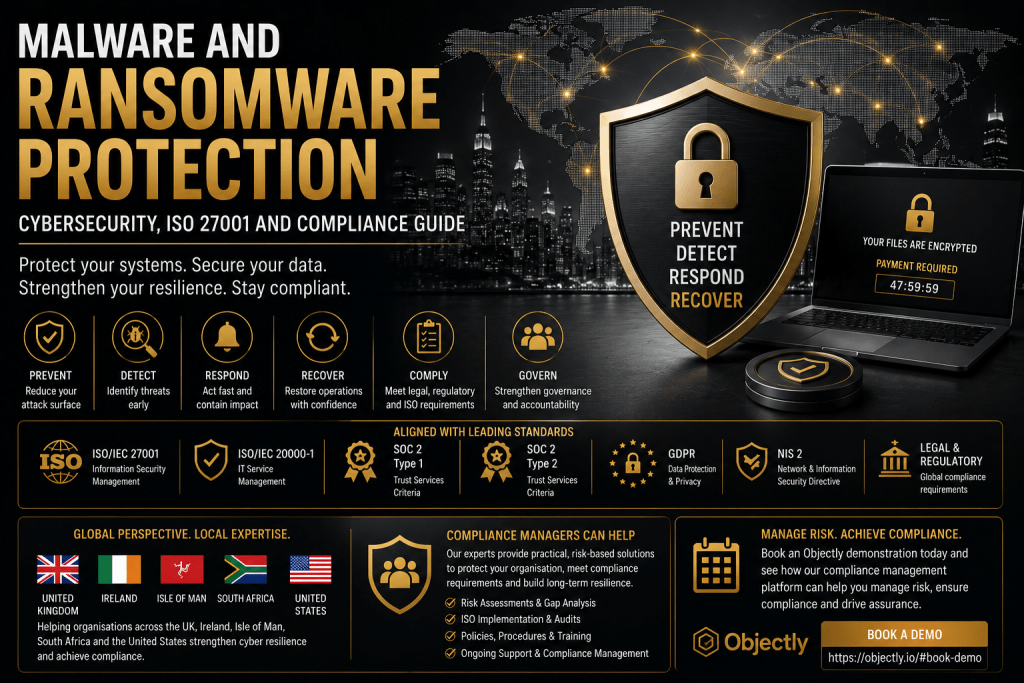
Malware and ransomware can disrupt operations, encrypt critical systems, expose personal data and create serious legal, contractual and reputational consequences. Effective protection requires more than antivirus software. Organisations need layered technical controls, trained employees, secure backups, tested incident response and clear governance.
This guide explains how businesses can reduce malware and ransomware risk, respond effectively to incidents and integrate cybersecurity with ISO/IEC 27001, ISO/IEC 20000-1, GDPR data protection, SOC 2 and wider Business Compliance obligations across the United Kingdom, Ireland, the Isle of Man, South Africa and the United States.
What Is Malware?
Malware is malicious software designed to disrupt, damage, spy on, control or gain unauthorised access to systems and data. Common forms include viruses, worms, trojans, spyware, keyloggers, rootkits, botnets and ransomware.
Malware can enter an organisation through phishing emails, compromised websites, malicious attachments, unpatched systems, stolen credentials, remote-access services, removable media and infected suppliers.
What Is Ransomware?
Ransomware is malware that encrypts systems or data, blocks access or threatens disclosure unless a payment is made. Modern ransomware attacks often combine encryption with data theft, extortion and pressure on customers, suppliers or employees.
The operational impact may include:
- loss of access to business systems;
- interruption of customer services;
- exposure of personal or confidential data;
- contractual breaches;
- regulatory notification duties;
- financial loss and recovery costs;
- reputational damage; and
- business continuity failures.
Why Ransomware Is a Governance Issue
Ransomware is not only an IT problem. It is a governance, risk, legal compliance and resilience issue. Directors and senior managers should understand:
- which systems are critical;
- how quickly they must be restored;
- where backups are stored;
- whether restoration has been tested;
- who can isolate compromised systems;
- which regulators, customers or insurers may need notification;
- how third-party services are protected; and
- what evidence is available for audit and investigation.
Leadership remains accountable for ensuring that suitable resources, competence and controls are in place.
How Malware and Ransomware Attacks Commonly Begin
Phishing and social engineering
Attackers use deceptive emails, messages, calls or websites to persuade users to disclose credentials, open files or approve access.
Unpatched vulnerabilities
Internet-facing systems, remote-access tools and applications may be exploited when security updates are delayed.
Weak or stolen credentials
Reused passwords, lack of multi-factor authentication and compromised accounts can provide direct access.
Third-party compromise
Suppliers, software providers and managed service providers can become routes into the organisation.
Misconfigured cloud services
Publicly exposed storage, excessive permissions and insecure integrations increase risk.
Remote working and unmanaged devices
Home networks, personal devices and inconsistent patching can create weaknesses outside the traditional office perimeter.
Core Controls to Reduce Malware and Ransomware Risk
1. Maintain a complete asset inventory
Organisations should know which systems, endpoints, applications, cloud services and suppliers are in use. Unknown assets cannot be managed effectively.
2. Apply secure configuration and patch management
Critical vulnerabilities should be prioritised and tracked through controlled remediation processes.
3. Use multi-factor authentication
MFA should be applied to remote access, privileged accounts, cloud services and other high-risk systems.
4. Restrict administrative privileges
Users should have only the permissions required for their roles. Privileged accounts should be separate, monitored and reviewed.
5. Deploy endpoint protection and monitoring
Endpoint detection and response, anti-malware tools, central logging and alerting can help identify suspicious activity.
6. Segment networks
Segmentation can reduce the ability of malware to spread across the organisation.
7. Protect email and web access
Email filtering, domain protection, attachment controls and safe browsing reduce common attack routes.
8. Secure backups
Backups should be isolated, protected from unauthorised modification and tested regularly. A backup that cannot be restored is not an effective control.
9. Train employees
Training should cover phishing, suspicious attachments, credential handling, incident reporting and remote-working risks.
10. Test incident response
Tabletop exercises and technical recovery tests should confirm that roles, communications and restoration processes work under pressure.
Backup Strategy for Ransomware Resilience
A robust backup strategy should define:
- which systems and data are backed up;
- backup frequency;
- retention periods;
- offline or immutable copies;
- encryption and access control;
- recovery time objectives;
- recovery point objectives;
- restoration testing; and
- ownership and reporting.
Critical systems should be prioritised according to business impact and continuity requirements.
What to Do During a Ransomware Incident
1. Activate the incident response plan
Escalate immediately to the defined incident team and senior management.
2. Contain the incident
Isolate affected systems, disable compromised accounts and prevent further spread.
3. Preserve evidence
Logs, system images, messages and access records may be required for investigation, insurers, regulators or law enforcement.
4. Assess business impact
Identify affected systems, data, customers, suppliers and legal obligations.
5. Communicate carefully
Use controlled internal and external communications. Avoid speculation and maintain accurate records.
6. Restore safely
Systems should be rebuilt or restored only after the compromise has been understood and risks have been reduced.
7. Review and improve
Complete a formal post-incident review, root-cause analysis and corrective-action programme.
Ransom Payments and Decision-Making
Payment decisions involve legal, ethical, operational, insurance and law-enforcement considerations. Paying a ransom does not guarantee data recovery, confidentiality or the removal of malicious access.
Organisations should obtain appropriate legal, cyber-response and insurance advice and should not make decisions without senior governance and documented risk assessment.
ISO/IEC 27001 and Ransomware Protection
ISO/IEC 27001 provides a risk-based information security management system. It can support ransomware resilience through:
- asset management;
- access control;
- vulnerability management;
- secure configuration;
- logging and monitoring;
- supplier security;
- incident management;
- backup and recovery;
- business continuity; and
- internal audit and management review.
Certification does not guarantee immunity from attack, but it provides a structured system for governance, risk treatment and continual improvement.
ISO/IEC 20000-1 and IT Service Resilience
ISO/IEC 20000-1 supports incident, problem, change, configuration, service continuity and supplier management. These processes are critical during malware and ransomware events.
Integrating cybersecurity with IT service management helps organisations restore services in a controlled way and address systemic causes.
SOC 2 Type 1 and SOC 2 Type 2
SOC 2 assurance may be relevant to technology and service providers. A SOC 2 Type 1 report evaluates control design at a specified date, while a SOC 2 Type 2 report assesses design and operating effectiveness over a period.
Ransomware-related controls may include access management, change control, monitoring, backup, incident response and supplier oversight.
GDPR Data Protection and Ransomware
A ransomware incident may constitute a personal data breach where personal data is lost, altered, disclosed or made unavailable. Organisations should assess confidentiality, integrity and availability impacts.
Data protection obligations may include:
- documenting the incident;
- assessing risk to individuals;
- notifying the relevant regulator where required;
- informing affected individuals in high-risk cases;
- reviewing processor responsibilities; and
- retaining evidence of decisions.
International Compliance Considerations
United Kingdom
UK organisations should consider the UK GDPR, Data Protection Act 2018, contractual obligations, sector regulation and relevant cyber guidance.
Ireland
Irish organisations operate under the EU GDPR and Irish law. Security-of-processing and breach-notification obligations should be built into incident response.
Isle of Man
Isle of Man organisations should assess local data protection, financial services and sector requirements.
South Africa
South African organisations should consider POPIA, sector obligations, contractual duties and cross-border processing.
United States
US businesses may need to address federal, state and sector-specific notification and cybersecurity requirements.
Common Ransomware Preparedness Failures
- backups connected to the same environment;
- no restoration testing;
- unpatched remote-access systems;
- shared administrator accounts;
- weak supplier oversight;
- incident plans that have never been exercised;
- no defined legal or regulatory escalation;
- poor asset inventories;
- incomplete logging; and
- management reports that focus only on technical detail.
Using a Compliance Management Platform
Malware and ransomware controls often span multiple teams, standards and obligations. A Compliance Management Platform can connect cybersecurity risks with:
- asset and supplier registers;
- ISO/IEC 27001 controls;
- incident records;
- backup tests;
- risk treatment plans;
- corrective actions;
- GDPR data protection assessments;
- internal audits; and
- management review.
To explore how cyber risk, incidents, actions and wider Business Compliance can be managed in one system, book an Objectly demonstration.
How Compliance Managers Can Help
Compliance Managers Group brings certified implementation and lead-auditor capability across ISO 9001, ISO 14001, ISO 45001, ISO/IEC 27001 and ISO/IEC 20000-1, supported by degree-level safety management education and more than 25 years of practical experience in business management, IT, IT support, IT security, systems development, legal compliance management, project management and operating businesses.
Support can include:
- cybersecurity and compliance gap analysis;
- ISO/IEC 27001 implementation;
- ISO/IEC 20000-1 service-management integration;
- ransomware preparedness reviews;
- incident response and business continuity planning;
- supplier-security reviews;
- GDPR data protection support;
- internal audits and ISO audit readiness;
- Compliance Management Solutions; and
- ongoing outsourced compliance management.
Frequently Asked Questions
Can ransomware be completely prevented?
No control can guarantee prevention, but layered security, backups, monitoring, training and incident response can reduce likelihood and impact.
Should a business pay a ransom?
The decision requires legal, operational, insurance and law-enforcement advice. Payment does not guarantee recovery.
Does ISO/IEC 27001 protect against ransomware?
ISO/IEC 27001 supports structured risk management and controls, but certification does not guarantee that an attack will not occur.
How often should backups be tested?
Testing frequency should be based on system criticality, recovery objectives and business risk.
Can ransomware trigger GDPR reporting?
Yes. If personal data is affected, the organisation must assess whether notification duties apply.
Who should own ransomware preparedness?
Technical teams operate many controls, but accountability should involve senior management, risk, compliance, legal, business continuity and suppliers.
Conclusion: Build Resilience Before an Incident
Malware and ransomware resilience depends on preparation, not reaction. Organisations need secure systems, tested backups, clear responsibilities, trained employees and reliable incident response.
The strongest approach integrates cybersecurity with ISO/IEC 27001, IT service management, data protection, supplier assurance, internal audit and management review. This gives organisations across the United Kingdom, Ireland, the Isle of Man, South Africa and the United States stronger evidence, faster recovery and more resilient Business Compliance.

Comments are closed