
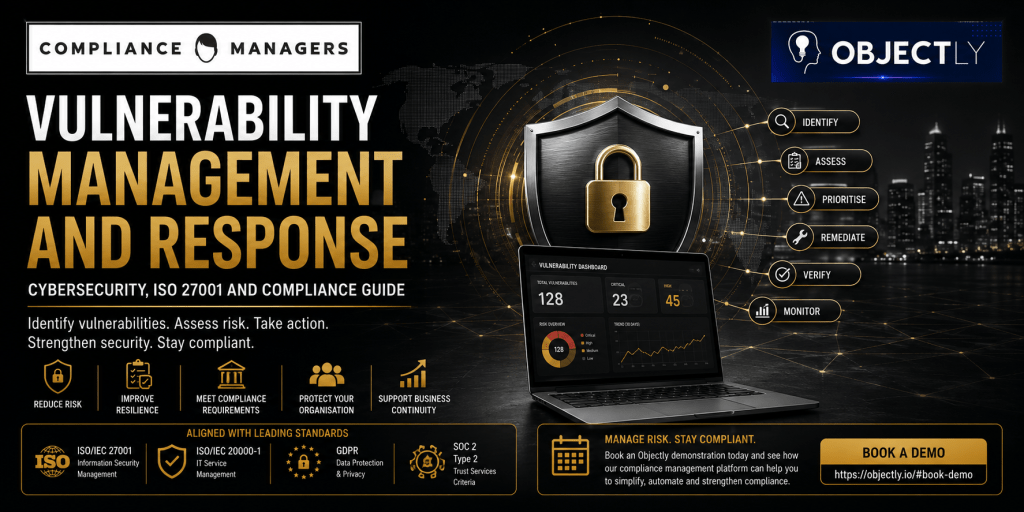
Vulnerability management is the controlled process used to identify, assess, prioritise, remediate and verify weaknesses in systems, software, cloud services and connected infrastructure. Effective vulnerability response is not only a technical activity. It is a governance, legal compliance, operational resilience and Business Compliance responsibility.
Organisations need accurate asset information, risk-based prioritisation, accountable owners, defined remediation timescales, evidence of closure and senior oversight. This guide explains how to build a mature vulnerability management programme aligned with ISO/IEC 27001, ISO/IEC 20000-1, GDPR data protection, SOC 2 and wider Risk and Compliance expectations across the United Kingdom, Ireland, the Isle of Man, South Africa and the United States.
Executive Summary
- Vulnerabilities must be managed through a repeatable business process, not isolated technical fixes.
- Asset discovery and ownership are fundamental because unknown systems cannot be protected effectively.
- Priority should reflect exploitability, business criticality, exposure, data sensitivity and active threat intelligence.
- Decisions to delay remediation should be formally risk-assessed and approved at the appropriate level.
- Temporary mitigations must be monitored and replaced by permanent fixes where possible.
- Closure should be verified through rescanning, testing or independent assurance.
- Vulnerability management should connect with change management, incident response, supplier assurance, internal audit and management review.
What Is Vulnerability Management?
Vulnerability management is the lifecycle used to discover weaknesses, evaluate risk, implement remediation or mitigation, verify effectiveness and continually improve the control environment.
A mature programme normally includes:
- asset discovery and inventory;
- vulnerability intelligence and monitoring;
- scanning and assessment;
- risk-based triage;
- remediation planning;
- change control;
- exception and risk acceptance;
- verification and closure;
- reporting and escalation; and
- periodic review and improvement.
Why Vulnerability Management Is a Business Compliance Issue
Technical vulnerabilities can create consequences far beyond the IT department. A weakness may lead to loss of service, personal data breaches, contractual failures, customer claims, regulatory scrutiny, operational disruption or financial loss.
Directors and senior managers should therefore understand:
- which systems are critical to the business;
- which vulnerabilities are exposed to the internet;
- whether active exploitation is occurring;
- who owns remediation;
- which actions are overdue;
- which risks have been formally accepted;
- how suppliers are being monitored; and
- whether closure has been independently verified.
Risk ownership must remain with the business. The security or IT team may provide technical advice, but senior management must understand and approve material residual risk.
What Is a Security Vulnerability?
A security vulnerability is a weakness that may be exploited to compromise confidentiality, integrity or availability. Vulnerabilities can arise from:
- software defects;
- missing patches;
- weak configuration;
- unsupported technology;
- excessive permissions;
- insecure coding;
- exposed services;
- poor authentication;
- supplier weaknesses;
- process failures; and
- human error.
Vulnerability Management vs Vulnerability Assessment
A vulnerability assessment identifies and evaluates weaknesses at a particular point in time. Vulnerability management is the wider ongoing process that includes ownership, prioritisation, remediation, governance and continual improvement.
Vulnerability Management vs Penetration Testing
Penetration testing attempts to exploit selected weaknesses to demonstrate practical impact. Vulnerability management provides continuous or scheduled discovery and remediation across the wider technology estate. Both activities are valuable but serve different purposes.
The Vulnerability Management Lifecycle
1. Establish Governance and Scope
Define the systems, networks, applications, cloud environments, sites, suppliers and legal entities covered by the programme. Establish accountability, reporting lines and risk-acceptance authority.
2. Identify Assets and Owners
Maintain a current inventory of hardware, software, cloud services, applications, mobile devices, internet-facing systems and third-party services. Every important asset should have a named business and technical owner.
3. Obtain Vulnerability Information
Use vendor alerts, scanning tools, threat intelligence, penetration testing, code review, security researchers and supplier notifications.
4. Scan and Assess
Assess internal systems, external assets, cloud environments, applications, endpoints and network devices at a frequency proportionate to risk.
5. Triage and Prioritise
Severity scores can support prioritisation but should not be used alone. Consider:
- active exploitation;
- internet exposure;
- asset criticality;
- data sensitivity;
- privilege required;
- availability of exploits;
- existing compensating controls;
- business impact; and
- recovery capability.
6. Assign Remediation Actions
Each material vulnerability should have an owner, target date, remediation plan and escalation route.
7. Apply Updates or Mitigations
Remediation may include patching, upgrading, reconfiguration, disabling services, restricting access, segmentation or replacing unsupported technology.
8. Manage Exceptions
Where remediation cannot be completed immediately, document the reason, residual risk, temporary controls, expiry date and approval.
9. Verify Closure
Rescan or retest the affected system. A ticket should not be closed solely because an update was reported as installed.
10. Review Performance
Analyse recurring weaknesses, overdue actions, root causes, supplier performance and systemic control failures.
How to Prioritise Vulnerabilities Effectively
Organisations often discover more vulnerabilities than they can remediate immediately. A risk-based model is therefore essential.
High priority normally includes:
- actively exploited vulnerabilities;
- critical internet-facing systems;
- weaknesses enabling remote code execution;
- privilege escalation on critical systems;
- vulnerabilities affecting sensitive personal or financial data;
- unsupported systems with no reliable mitigation; and
- weaknesses in identity, backup or security-management infrastructure.
Remediation Timescales and Service Levels
Remediation targets should be based on risk and organisational capability. A useful policy defines different timescales for critical, high, medium and low-risk findings, with accelerated response where active exploitation is confirmed.
Targets should also distinguish between:
- internet-facing and internal systems;
- production and development environments;
- critical and non-critical services;
- vendor-supported and unsupported technology; and
- temporary mitigation and permanent remediation.
Vulnerability Management and Patch Management
Patch management is a key part of vulnerability management, but the two are not identical. Some vulnerabilities require configuration changes, access restrictions, architecture changes or system replacement rather than a software patch.
Vulnerability Management and Change Control
Security updates can affect availability and compatibility. Remediation should therefore integrate with change management, testing, rollback arrangements and service-continuity planning.
Emergency changes should remain controlled, documented and reviewed after implementation.
Vulnerability Management and Incident Response
A known vulnerability may become a security incident when exploitation is suspected or confirmed. The organisation should be able to:
- identify affected assets;
- isolate systems;
- preserve evidence;
- assess data impact;
- apply emergency mitigation;
- notify relevant stakeholders;
- restore services safely; and
- complete root-cause analysis.
Vulnerability Disclosure and Reporting
Organisations should provide a clear and secure method for employees, customers and independent researchers to report suspected vulnerabilities.
A disclosure process should define:
- reporting channels;
- scope and acceptable testing;
- acknowledgement timescales;
- triage and escalation;
- communication with the reporter;
- remediation and disclosure decisions; and
- legal and confidentiality considerations.
Supplier and Third-Party Vulnerability Management
Suppliers may host critical systems, process personal data or provide software that becomes part of the organisation’s attack surface.
Supplier controls should address:
- security responsibilities;
- notification of critical vulnerabilities;
- patching and support commitments;
- penetration testing;
- subcontractors and cloud providers;
- end-of-life technology;
- incident notification; and
- evidence such as ISO/IEC 27001 or SOC 2 reports.
Vulnerability Management and ISO/IEC 27001
ISO/IEC 27001:2022 requires organisations to establish a risk-based information security management system. Vulnerability management supports asset control, threat intelligence, secure configuration, technical vulnerability management, logging, monitoring, supplier security, incident response and continual improvement.
Evidence for an ISO audit may include:
- vulnerability management policy;
- asset inventory;
- scan schedules and reports;
- risk-rating methodology;
- remediation records;
- approved exceptions;
- verification evidence;
- supplier reviews;
- internal audits; and
- management reports.
Vulnerability Management and ISO/IEC 20000-1
ISO/IEC 20000-1 supports integration with incident, problem, change, configuration, service continuity and supplier management. Repeated vulnerabilities often reveal weaknesses in these underlying service-management processes.
Vulnerability Management and SOC 2
SOC 2 Type 1 evaluates control design at a specified date. SOC 2 Type 2 evaluates design and operating effectiveness over a review period.
Vulnerability management may support controls relating to system monitoring, access, secure development, change management, incident response and supplier assurance.
GDPR Data Protection and Vulnerabilities
Security vulnerabilities can affect personal data confidentiality, integrity and availability. Organisations should implement appropriate technical and organisational measures and be able to demonstrate accountability.
A vulnerability may require a personal data breach assessment where exploitation, disclosure, loss or unavailability is suspected.
International Compliance Considerations
United Kingdom
UK organisations should align vulnerability management with the UK GDPR, Data Protection Act 2018, sector regulation, contractual requirements and current NCSC guidance.
Ireland
Irish organisations operate under the EU GDPR, Irish law and relevant EU cybersecurity obligations. Regulated and essential entities may have additional risk-management and incident-reporting duties.
Isle of Man
Isle of Man organisations should assess local data protection, financial services and sector-specific requirements rather than assuming UK rules automatically apply.
South Africa
South African organisations should consider POPIA, contractual security requirements, sector expectations and cross-border data processing.
United States
US organisations may need to address federal, state and sector-specific cybersecurity, privacy and breach-notification requirements.
Vulnerability Management for Different Organisation Sizes
Small Businesses
Small organisations should begin with critical assets, internet-facing services, supported software, automatic updates, secure backups and clear supplier responsibilities.
Medium-Sized Organisations
Medium-sized businesses often need central scanning, defined remediation targets, formal risk acceptance and regular reporting.
Large and International Organisations
Large organisations need global standards, local ownership, integrated toolsets, consistent metrics and governance across multiple legal entities and technology estates.
Vulnerability Management Maturity Model
Level 1: Reactive
Vulnerabilities are addressed only after incidents or urgent alerts.
Level 2: Basic
Scanning occurs, but ownership, prioritisation and closure evidence are inconsistent.
Level 3: Controlled
Assets, policies, service levels, actions and exceptions are formally managed.
Level 4: Managed
Performance is measured, trends are analysed and risk informs priorities.
Level 5: Optimised
Vulnerability management is integrated with threat intelligence, secure development, automation, suppliers and enterprise risk.
Key Vulnerability Management Metrics
- asset coverage;
- critical vulnerabilities by business service;
- mean time to remediate;
- percentage remediated within target;
- overdue critical and high findings;
- accepted risks and expiry dates;
- repeat vulnerabilities;
- unsupported assets;
- external exposure;
- supplier remediation performance; and
- verification failure rate.
Common Vulnerability Management Failures
- incomplete asset inventories;
- relying only on severity scores;
- no business ownership;
- unrealistic remediation targets;
- temporary fixes left permanently;
- closing actions without rescanning;
- unsupported technology retained without a plan;
- poor supplier visibility;
- no formal risk acceptance;
- weak change control;
- limited reporting to leadership; and
- failure to learn from recurring findings.
Using a Compliance Management Platform
Scanning tools identify technical findings, but organisations still need governance, ownership, risk decisions, evidence and management reporting.
A Compliance Management Platform can connect vulnerability findings with:
- assets and business owners;
- risk registers;
- legal and contractual obligations;
- ISO/IEC 27001 controls;
- suppliers;
- incidents;
- change requests;
- corrective actions;
- internal audits; and
- management review.
To see how vulnerability risks, actions, evidence and wider Business Compliance can be managed in one system, book an Objectly demonstration.
How Compliance Managers Can Help
Compliance Managers Group brings certified implementation and lead-auditor capability across ISO 9001, ISO 14001, ISO 45001, ISO/IEC 27001 and ISO/IEC 20000-1, supported by degree-level safety management education and more than 25 years of practical experience in business management, IT, IT support, IT security, systems development, legal compliance management, project management and operating businesses.
Support can include:
- vulnerability management gap analysis;
- policy and process design;
- asset and risk-register development;
- ISO/IEC 27001 implementation;
- ISO/IEC 20000-1 integration;
- supplier-security reviews;
- GDPR data protection support;
- internal audits and ISO audit readiness;
- Compliance Management Solutions; and
- ongoing outsourced compliance support.
Frequently Asked Questions
How often should vulnerability scans be performed?
Frequency should reflect risk, rate of change, exposure and asset criticality. Critical external systems may require continuous monitoring.
Who owns vulnerability risk?
Technical teams manage remediation, but business owners and senior management must own material residual risk.
Is a high CVSS score always the highest priority?
No. Active exploitation, exposure, business impact and compensating controls must also be considered.
Does ISO/IEC 27001 require vulnerability scanning?
The standard requires organisations to manage technical vulnerabilities appropriately. The exact tools and frequency should be risk-based.
Can a vulnerability create a GDPR breach?
A vulnerability alone is not necessarily a breach, but suspected exploitation or loss of confidentiality, integrity or availability may trigger breach assessment.
What is a vulnerability exception?
An exception is a formally approved decision to delay or avoid remediation, supported by documented risk, controls, ownership and an expiry date.
How should closure be verified?
Use rescanning, retesting, configuration review or independent assurance to confirm that the weakness is no longer present.
Conclusion: Vulnerability Response Requires Governance
Effective vulnerability management depends on asset visibility, risk-based prioritisation, clear ownership, controlled remediation and verified closure. Scanning alone is not enough.
The strongest programmes integrate technical vulnerability response with ISO/IEC 27001, IT service management, supplier assurance, data protection, internal audit and management review. This gives organisations across the United Kingdom, Ireland, the Isle of Man, South Africa and the United States stronger resilience, clearer evidence and more effective Business Compliance.


Comments are closed