
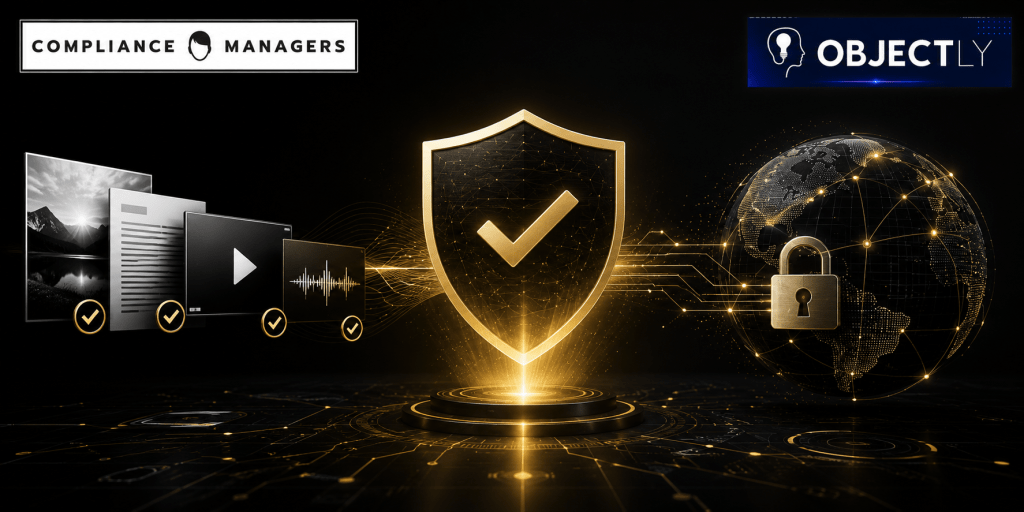
Digital provenance technologies help organisations establish where digital content came from, how it has changed and whether its authenticity can be verified. As AI-generated media, deepfakes, manipulated documents and synthetic content become more sophisticated, provenance is becoming an important part of cybersecurity, information governance, regulatory compliance and public trust.
This guide explains digital provenance from the perspective of experienced compliance managers, ISO implementers, lead auditors and systems professionals. It covers cryptographic signing, metadata, content credentials, blockchain-based approaches, AI governance, ISO/IEC 27001, GDPR data protection, supplier assurance and international compliance considerations across the United Kingdom, Ireland, the Isle of Man, South Africa and the United States.
Executive Summary
- Digital provenance records the origin, history and integrity of digital content.
- It can help organisations distinguish authentic content from manipulated or synthetic material.
- Provenance should be treated as part of governance and risk management rather than as a standalone technical feature.
- Cryptographic signatures, trusted metadata and tamper-evident records are common enabling technologies.
- Provenance controls can support cybersecurity, AI governance, data protection, evidential integrity and customer trust.
- They do not eliminate misinformation, fraud or cyber risk and must be combined with human review, policy and accountability.
What Is Digital Provenance?
Digital provenance is the documented history of a digital asset, including its origin, ownership, creation process, changes, approvals and distribution.
A provenance record may answer questions such as:
- Who created the content?
- When was it created?
- Which system generated or modified it?
- Was AI involved?
- Has the content been edited?
- Who approved publication?
- Can its integrity be verified?
- Which organisation or individual is accountable for it?
Why Digital Provenance Matters
Digital content is increasingly easy to create, copy and alter. Generative AI has accelerated this trend by making realistic text, images, audio and video accessible to almost anyone.
For organisations, the resulting risks include:
- deepfake fraud;
- fake executive communications;
- manipulated evidence;
- misleading marketing;
- unauthorised AI-generated content;
- copyright or ownership disputes;
- falsified supplier documentation;
- reputational damage; and
- regulatory or contractual breaches.
How Digital Provenance Works
Trusted Metadata
Metadata can record information about creation, authorship, editing, system use and publication. The challenge is ensuring that metadata itself cannot be changed without detection.
Cryptographic Signatures
Digital signatures can demonstrate that content was signed by a trusted source and has not been altered since signing.
Content Credentials
Content credentials can attach verifiable information about how an image, video or other asset was created or modified.
Hashing
Cryptographic hashes create a unique representation of content. Changes to the file normally produce a different hash, supporting integrity checks.
Distributed or Tamper-Evident Records
Some systems use distributed ledgers or other tamper-evident mechanisms to record events and establish a trustworthy audit trail.
Digital Provenance and Artificial Intelligence
AI governance increasingly requires organisations to understand where outputs came from, how models were used and whether content has been reviewed by a human.
A mature AI provenance framework may record:
- the AI model or service used;
- the date and purpose of use;
- input sources;
- human reviewers;
- approvals;
- material edits;
- publication status; and
- retention requirements.
Deepfakes and Synthetic Media Risk
Deepfakes can imitate executives, employees, customers or public figures. The risk is not limited to misinformation; synthetic media can support payment fraud, social engineering, extortion and reputational attacks.
Organisations should combine provenance with:
- multi-factor authentication;
- payment verification controls;
- out-of-band confirmation;
- employee awareness;
- incident response;
- brand monitoring; and
- clear escalation procedures.
Digital Provenance and ISO/IEC 27001
ISO/IEC 27001 supports the governance of information-security risks, including information integrity, access control, supplier security, logging, monitoring and incident management.
Digital provenance can strengthen:
- information classification;
- data integrity;
- audit trails;
- change control;
- identity and access management;
- supplier assurance;
- incident investigation; and
- evidence for ISO audits.
Digital Provenance and ISO/IEC 20000-1
IT service-management processes can support provenance through configuration management, change management, incident handling, service records and controlled release processes.
Digital Provenance and GDPR Data Protection
Provenance records may themselves contain personal data, including names, identifiers, system logs and approval information. Organisations must therefore consider lawful processing, access control, retention, accuracy and data subject rights.
Where provenance is used to demonstrate authenticity, organisations should ensure that the records are proportionate and do not create unnecessary privacy risks.
Supplier and Third-Party Assurance
Organisations increasingly depend on external platforms, AI providers, cloud services and content suppliers. Provenance controls can support supplier assurance by demonstrating:
- who produced content;
- which system was used;
- whether AI was involved;
- what changes were made;
- who approved publication; and
- whether integrity checks remain valid.
Governance Framework for Digital Provenance
1. Define Scope
Identify which content types, systems, brands and business processes require provenance controls.
2. Assign Ownership
Define responsibility across IT, cybersecurity, compliance, legal, communications, marketing and AI governance teams.
3. Establish Standards
Set minimum requirements for metadata, signatures, approvals, retention and verification.
4. Classify High-Risk Content
Prioritise executive communications, regulated information, customer documentation, financial approvals and public-facing media.
5. Integrate with Existing Controls
Connect provenance with identity management, document control, change management, incident response and supplier assurance.
6. Define Verification Processes
Specify how employees, customers or systems should verify authenticity.
7. Monitor and Review
Use audits, incidents, complaints and management reporting to test effectiveness.
International Compliance Considerations
United Kingdom
UK organisations should consider the UK GDPR, Data Protection Act 2018, cybersecurity guidance, consumer protection obligations and sector regulation when implementing provenance controls.
Ireland
Irish organisations operate under the EU GDPR and wider EU digital regulation. Provenance may support transparency, security and AI governance obligations.
Isle of Man
Isle of Man organisations should assess local data protection, financial services and sector requirements, particularly where digital content crosses borders.
South Africa
South African organisations should consider POPIA, cybersecurity, evidential requirements and contractual duties when using provenance technologies.
United States
US organisations may need to consider state privacy laws, sector-specific obligations, consumer protection, intellectual property and emerging AI governance requirements.
Digital Provenance Maturity Model
Level 1: Informal
Content origin and approval are based largely on individual knowledge.
Level 2: Documented
Policies exist, but metadata, approval and verification are inconsistent.
Level 3: Controlled
High-risk content has defined provenance, ownership and approval records.
Level 4: Assured
Cryptographic controls, monitoring and audits test provenance effectiveness.
Level 5: Optimised
Provenance is automated, integrated with AI governance and used across enterprise risk management.
Key Metrics for Digital Provenance
- percentage of high-risk content with verified provenance;
- content requiring manual verification;
- failed authenticity checks;
- unapproved AI-generated content;
- supplier provenance exceptions;
- time to verify disputed content;
- deepfake or impersonation incidents;
- policy exceptions; and
- audit findings.
Common Provenance Implementation Failures
- treating provenance as a technology purchase rather than a governance process;
- capturing metadata without protecting its integrity;
- no clear content ownership;
- failing to distinguish AI-generated from human-generated content;
- excessive collection of personal data;
- weak supplier controls;
- no user-friendly verification method;
- poor incident response for manipulated content; and
- no management reporting.
Using a Compliance Management Platform
Digital provenance controls often span policies, risks, suppliers, AI systems, approvals, incidents and audit evidence. A Compliance Management Platform can provide the governance layer that connects these activities.
Effective Compliance Management Tools can help organisations:
- maintain AI and information-governance policies;
- assign content and system owners;
- record risk assessments;
- track supplier assurance;
- manage incidents and corrective actions;
- link controls to ISO/IEC 27001;
- retain approval evidence; and
- produce management reports.
To see how information governance, AI risk, evidence and wider Business Compliance can be managed in one system, book an Objectly demonstration.
How Compliance Managers Can Help
Compliance Managers Group brings certified implementation and lead-auditor capability across ISO 9001, ISO 14001, ISO 45001, ISO/IEC 27001 and ISO/IEC 20000-1, supported by degree-level safety management education and more than 25 years of practical experience in business management, IT, IT support, IT security, systems development, legal compliance management, project management and operating businesses.
Support can include:
- digital provenance and governance gap analysis;
- AI governance frameworks;
- ISO/IEC 27001 implementation;
- information-classification and integrity controls;
- supplier assurance;
- GDPR data protection support;
- internal audits and ISO audit readiness;
- Compliance Management Solutions; and
- ongoing outsourced compliance support.
Frequently Asked Questions
What is digital provenance?
Digital provenance is the verifiable history of a digital asset, including its origin, changes, ownership and approval.
Can provenance prove that content is true?
No. Provenance can help verify origin and integrity, but authentic content can still be inaccurate or misleading.
Does blockchain guarantee provenance?
No. Distributed ledgers may provide tamper-evident records, but governance, identity and data-quality controls remain essential.
Can provenance help detect deepfakes?
It can help demonstrate that trusted content has a verifiable origin, but it should be combined with detection, verification and incident-response controls.
How does ISO/IEC 27001 relate to provenance?
ISO/IEC 27001 supports information integrity, access control, logging, supplier security and risk management, all of which can strengthen provenance.
Is provenance relevant to AI governance?
Yes. It can document which AI systems were used, how outputs were reviewed and who approved publication.
Conclusion: Trust Requires Verifiable Evidence
Digital provenance is becoming an important component of trust in the digital economy. As organisations rely more heavily on AI-generated and digitally distributed content, they need stronger evidence of origin, integrity and accountability.
The most effective approach integrates provenance with cybersecurity, AI governance, data protection, supplier assurance, ISO/IEC 27001 and management oversight. Compliance Managers can help organisations across the United Kingdom, Ireland, the Isle of Man, South Africa and the United States design controls that strengthen trust without creating unnecessary complexity.

Comments are closed