
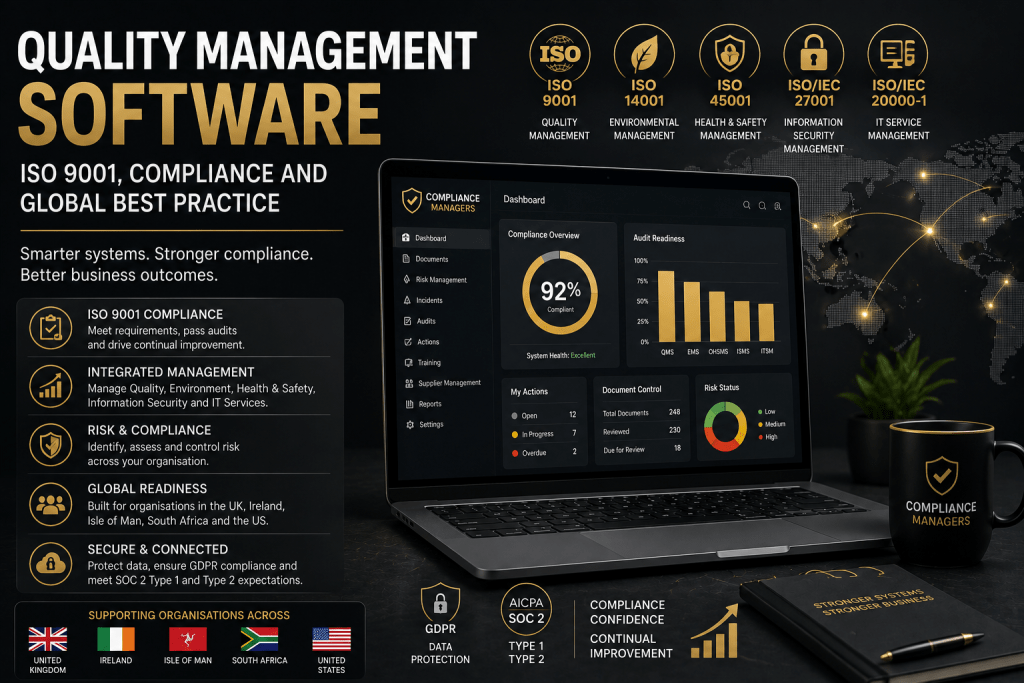
Quality management software helps organisations control processes, improve product and service consistency, manage evidence and prepare for audits. For businesses operating across the United Kingdom, Ireland, the Isle of Man, South Africa and the United States, the strongest systems also connect quality management with wider Risk and Compliance responsibilities.
The original announcement around SunQ, developed through collaboration between Techkon USA and Sun Chemical, highlights a wider market shift: quality teams increasingly need digital tools that combine measurement, workflow, reporting and traceable evidence. This guide explains what quality management software should do, how it can support ISO 9001 and other ISO standards, and what international organisations should consider before choosing a platform.
What Is Quality Management Software?
Quality management software is a digital system used to plan, control, monitor and improve quality-related activities. It may support document control, inspections, corrective actions, supplier management, customer complaints, audits, training, risk registers and performance reporting.
The purpose is not simply to replace paper forms or spreadsheets. A strong Compliance Management Platform should create a reliable system of record, provide clear ownership and generate evidence that can be reviewed by managers, customers, regulators and auditors.
Why Quality Management Software Matters
As organisations grow, quality information often becomes fragmented across shared drives, email chains, spreadsheets and departmental systems. This creates several risks:
- outdated procedures may remain in use;
- corrective actions may be missed or closed without evidence;
- supplier problems may not be linked to business risk;
- audit findings may be duplicated or lost;
- management reports may be based on incomplete data; and
- certification evidence may take too long to retrieve.
Effective Compliance Management Tools reduce these weaknesses by creating a consistent workflow from issue identification through investigation, action, verification and improvement.
How Quality Management Software Supports ISO 9001
ISO 9001 is the globally recognised standard for quality management systems. It requires organisations to establish, implement, maintain and continually improve a quality management system that supports customer satisfaction and consistent performance.
Quality management software can support ISO 9001 by helping organisations manage:
- organisational context and interested parties;
- quality objectives and performance measures;
- documented information;
- risk and opportunity registers;
- competence and training records;
- supplier approval and monitoring;
- customer complaints and feedback;
- nonconformities and corrective actions;
- internal audits;
- management review evidence; and
- continual improvement.
Some users search for “ISO 9001 2018”, but the recognised published edition remains ISO 9001:2015, with a climate-action amendment issued in 2024 and a revised edition expected in 2026.
Using One Platform for Multiple ISO Standards
Many organisations need to manage more than quality. ISO management-system standards share a common structure, which makes integration possible. A central Compliance Management Platform can map shared controls across an ISO Standards List that may include:
- ISO 9001 for quality management;
- ISO 14001 for environmental management;
- ISO 45001 for occupational health and safety;
- ISO/IEC 27001 for information security; and
- ISO 22301 for business continuity.
This integrated approach can reduce duplicated audits, policies, actions and management reviews while giving leadership a clearer view of Business Compliance.
Key Features to Look For
Document and policy control
The system should manage approvals, version history, review dates, ownership and access. Employees should be able to identify the current approved document without uncertainty.
Corrective and preventive action workflows
Users should be able to record a nonconformity, investigate root causes, assign actions, set deadlines and verify effectiveness before closure.
Audit management
A good platform should support audit planning, checklists, evidence, findings, actions and reporting. This improves readiness for an internal review or external ISO audit.
Supplier quality management
Supplier records should include approval status, risk rating, due diligence, performance history, incidents and corrective actions.
Training and competence
The platform should link roles to required competence, training records and refresher dates.
Risk and compliance registers
Quality risks should connect with wider operational, legal, environmental, safety, information-security and strategic risks.
Dashboards and reporting
Management should be able to monitor overdue actions, recurring issues, supplier performance, complaints, audit findings and objective progress.
Integration and access control
The system should support appropriate permissions, authentication, audit logs and integration with other business applications.
Quality Management Software and Data Protection
Quality systems often hold personal data, including employee training records, customer complaints, supplier contacts and investigation evidence. Data protection must therefore be considered during selection and implementation.
United Kingdom
UK organisations should align platform use with the UK GDPR and the Data Protection Act 2018. Controls should address lawful processing, access, retention, security and data subject rights.
Ireland
Organisations in Ireland operate under the EU GDPR and Irish data-protection law. The Irish Data Protection Commission is the national supervisory authority. Businesses should assess hosting, international transfers, processor contracts and breach procedures.
Isle of Man
Isle of Man organisations should consider the island’s data-protection framework, including requirements that broadly reflect modern GDPR principles. Local legal advice may be needed where processing involves cross-border data flows.
South Africa
South African businesses must consider the Protection of Personal Information Act, commonly known as POPIA. Quality-management data should be processed securely and for defined purposes, with controls over access, retention and cross-border transfers.
United States
The United States does not have a single comprehensive federal privacy law equivalent to GDPR. Organisations may need to consider sector-specific rules and state privacy laws depending on their location, customers and data. A national platform should support configurable retention, access and privacy controls.
Quality Management Software and SOC 2
Software providers may use SOC 2 reports to demonstrate controls relevant to security, availability, confidentiality, processing integrity and privacy. A SOC 2 Type 1 report assesses control design at a specified date, while a SOC 2 Type 2 report assesses both design and operating effectiveness over a review period.
When evaluating a provider, review the report’s scope, system description, testing period, exceptions and complementary user-entity controls. SOC 2 does not replace your own supplier due diligence.
Global Implementation Considerations
United Kingdom
UK organisations often select quality management software to support ISO certification, public-sector tenders, regulated supply chains and customer assurance. UKAS-accredited certification may be commercially important in many sectors.
Ireland
Irish businesses may need a platform that supports EU regulatory expectations, multilingual or multi-site operations and cross-border customer requirements. GDPR accountability should be integrated with quality and supplier management.
Isle of Man
Businesses on the Isle of Man may benefit from flexible systems that support local governance while also satisfying UK, EU and international customer requirements.
South Africa
South African organisations should consider local legal obligations, POPIA, occupational health and safety, supplier development and the practical realities of distributed operations.
United States
US organisations may place greater emphasis on customer assurance, sector regulation, state privacy requirements, SOC 2 and scalable multi-state operations. The platform should support configurable workflows rather than a single-jurisdiction model.
Common Implementation Mistakes
- Buying software before defining processes: technology cannot correct unclear responsibilities or ineffective workflows.
- Over-customising: excessive configuration can make upgrades, training and support more difficult.
- Migrating poor data: outdated documents and unresolved actions should be reviewed before import.
- Ignoring users: adoption fails when the system is designed only for auditors or administrators.
- Failing to define metrics: dashboards are only useful when measures support real business objectives.
- Treating certification as the only goal: the system should improve operations beyond the ISO audit.
How to Select a Compliance Management Platform
Before purchasing, define the business requirements and evaluate potential systems against a structured checklist:
- Which standards and jurisdictions must be supported?
- Which processes will be managed in the platform?
- How many sites, teams and external users need access?
- What integrations are required?
- Where is data hosted?
- What security assurance is available?
- Can evidence be exported if the contract ends?
- How are changes, backups and incidents managed?
- What implementation and support services are included?
- Can the system grow with future standards and markets?
How Compliance Managers Can Help
Compliance Managers provides practical Compliance Management Solutions for organisations selecting, implementing or improving quality and compliance systems across the UK, Ireland, the Isle of Man, South Africa and the United States.
Support can include:
- quality-management and compliance gap analysis;
- ISO 9001, ISO 14001, ISO 45001 and ISO/IEC 27001 implementation;
- platform requirements and supplier evaluation;
- process design and data migration planning;
- risk-register and audit-framework development;
- GDPR data protection and POPIA alignment;
- internal audits and ISO audit preparation; and
- ongoing Business Compliance support.
Frequently Asked Questions
What is the difference between quality management software and a Compliance Management Platform?
Quality software focuses primarily on products, services and quality processes. A broader compliance platform may also manage legal obligations, information security, data protection, health and safety, environmental management and enterprise risk.
Is quality management software required for ISO 9001?
No. ISO 9001 does not require a particular software product. Organisations may use suitable manual or digital systems, provided they can demonstrate effective control and evidence.
Can quality software help with ISO certification?
Yes. It can improve document control, audit readiness, corrective actions, risk management and evidence retrieval. Certification still depends on effective implementation.
Should the software provider have SOC 2 Type 2 or ISO/IEC 27001?
These forms of assurance can support supplier evaluation, but they should be reviewed for scope and relevance. Neither automatically guarantees that the platform meets your legal, operational or security requirements.
Can one platform support multiple countries?
Yes, provided the system supports configurable workflows, permissions, retention rules, reporting and jurisdiction-specific obligations.
Conclusion: Use Technology to Improve the Management System
Quality management software can strengthen ISO 9001 implementation, audit readiness and continual improvement, but the technology must support well-designed processes and clear accountability. The strongest systems connect quality with Risk and Compliance, data protection, suppliers and business performance.
For international organisations, the platform should also support the different legal and commercial environments of the United Kingdom, Ireland, the Isle of Man, South Africa and the United States. Compliance Managers can help define requirements, select appropriate Compliance Management Tools and build a system that delivers value beyond certification.

Comments are closed